

Cooking Method, Cooking Method, which one is the best of all?
A cook-off between a pressure cooker, stovetop & Instant Pot


A few weeks back I wrote about how important pressure cookers (PCs) are to Indian kitchens and how the current depressing geo-political climate underscores the fuel-saving functionality of PCs. And precisely it is this feature that makes Indians and the IAPF evangelical about PCs. Remember how the IAPF ridiculed my mother under the garb of amazement because she did not have a PC for the longest time.
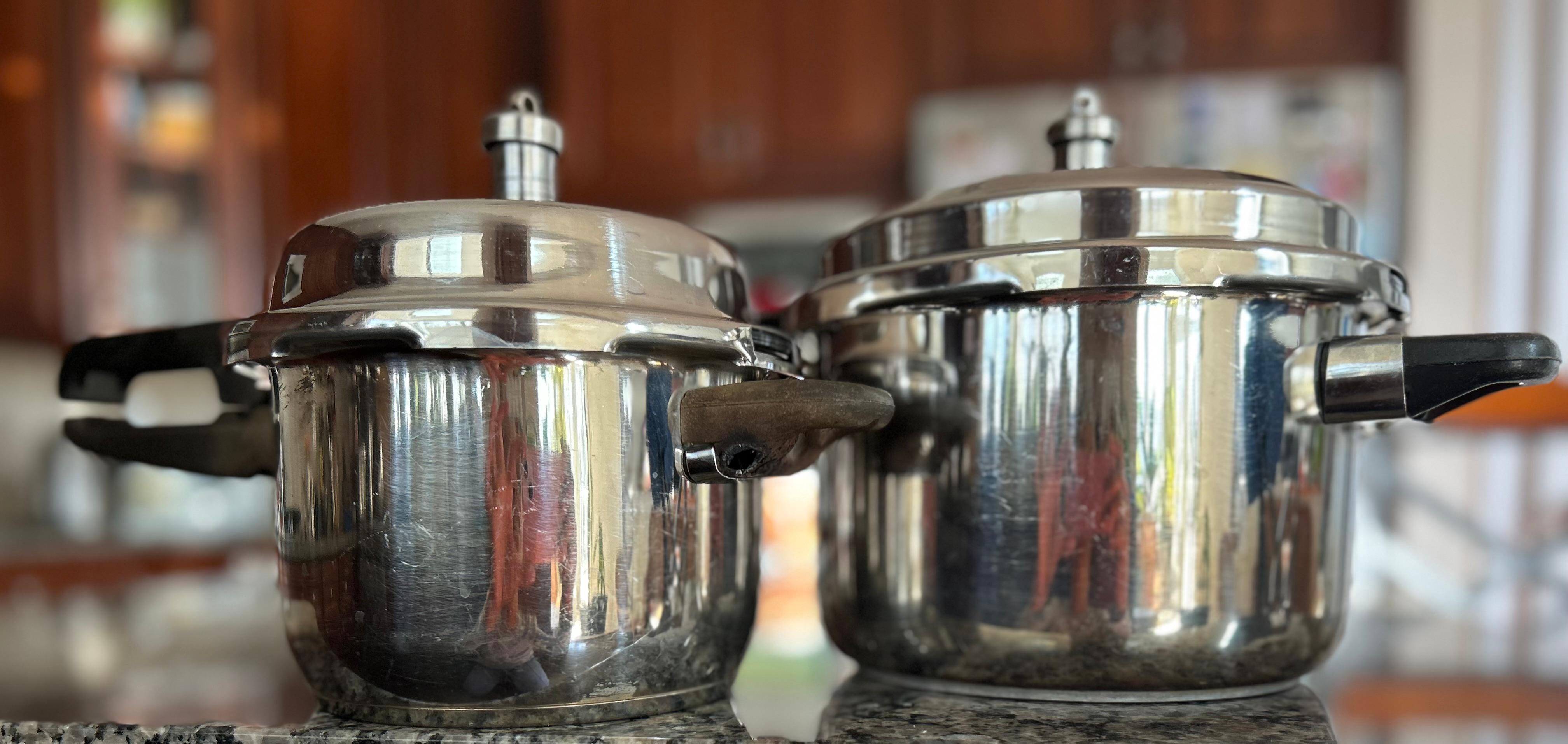

Well, all these hot takes led to vigorous discussion and robust engagement about legumes and how to walk the fine line between saving fuel and creating magical texture of legumes. One thing led to another and before long Harshita saxena, Lisa McLean and I hit upon the idea of a joint post to compare pressure cooking, stovetop cooking and Instant Pot cooking. And the dish we decided to conduct this comparative test on is rajma - a kidney bean stew from North India. Paired with rice, it is the comfort food of many North Indians.
Kidney bean is notorious to cook, and the frustration of inconsistently cooked beans or tough beans is common. I have most definitely faced it many times and being a recipe developer and food writer, I’m a little tired of chalking up these sub-par results to aged beans. So we decided to crack the code of kidney beans and compare which cooking method was the best.
But first things first -
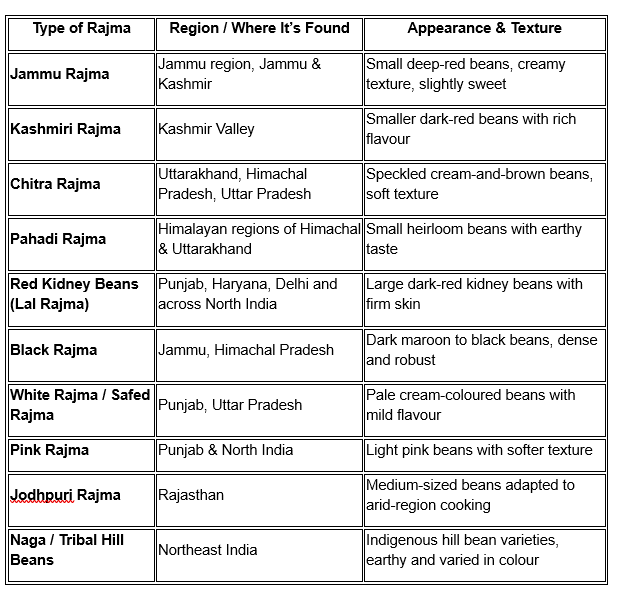
Types of Kidney beans (courtesy Harshita saxena)
And here’s a map of India if you want to place the states and the regions where rajma is found -
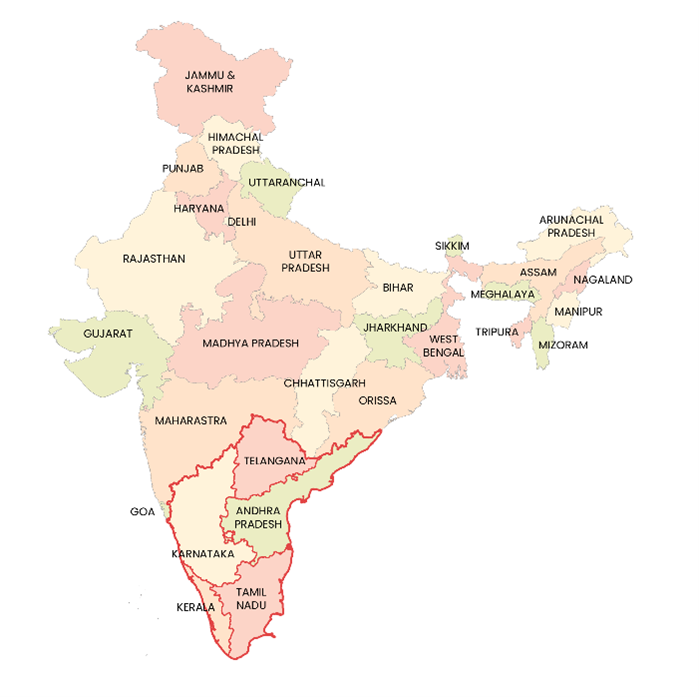
(Please ignore the highlights to the southern states of India).
Like tomatoes and chile peppers, it’s hard to believe that rajma (please note that the cooked stew as well as dry kidney bean are called rajma) is not native to India
And of course, because I did not know better before I read Harshita’s table, I have always cooked with red kidney beans, the toughest one to crack of all.

Cooking rajma in a pressure cooker

I love my two PCs. I have them in my daily rotation so cooking beans in a PC feels super organic to my culinary process and style. On one hand, it gives me satisfaction that I am not wasting cooking gas and on the other, I don’t have to go through the discomfort of hauling a bulky device from my bottom shelf to the counter.
Have you seen my post from last week with the recipe of rajma or rajma masala?
A precursor to this joint article, this post contained my recipe adapted from Chef Sanjyot Keer, YFL. One of the highlights of the original recipe was the ratio of 3 times water to 1-part dry kidney beans. And after pressure cooking, this bean-to-water proportion ensured a silky, velvety sauce, perfect to coat rice or paratha, your carb of choice.
As long as you know the amount of water/broth/liquid to add, the resulting consistency of the dish is highly desirable. For example, the pressure-cooked khichdi is a thing of beauty because the ultimate consistency is creamy and cohesive and makes you feel secure like in the honeymoon period of a relationship.
After pressure cooking, the beans were cooked - some broke down and some fully intact, and they broke down with a slight press. But opinions were divided and some in my family felt that they should become so soft that even a gentle press should not be required. But I was more concerned about the inconsistent cooking and believe that the old age of beans is responsible for this discrepancy. Another point to be noted is that the red kidney bean is a variety with the firmest of skins.
I couldn’t be happier to collaborate with Lisa McLean and Harshita saxena . Both are supremely passionate about their work and willing to research a topic to the end of the world. While Harshita loves to dig deep into the provenance of traditional recipes.

Apart from the breadth of global culinary knowledge that Lisa covers in her posts, the science corner is the absolute killer. And what I really admire about Lisa is she does not stop at the expected. She will go the extra mile and encourage us to do the same. In her rajma masala post, she not only gives two ways to cook rajma - one quick and easy for the weekday and one languorous for the weekend. And on top of this there is a special spice mix - aka rajma masala. How cool is that?

LISA’S WORDS
Cooking rajma on stovetop and oven
Slow cooking, flavour development, and layered heat
My own approach to rajma in this collaboration comes from the stovetop and from the slower arc of oven cooking. I was interested in what happens when you give the pot more time, allowing the beans and masala to settle into one another gradually. My work often moves between storytelling, kitchen practice, nutrition, and food science, and beans are one of those ingredients that reward exactly that kind of attention. On Culinary Repertoire, I write across recipes, spice traditions, and Science Corner essays, where evidence, tradition, and kitchen practice meet. In this collaboration, I am bringing the slower heat, the layering of flavour, and the textures that emerge when time is given room to work.
My own version follows a slower path. I used Jammu Rajma, soaked for 24 hours. The fresh beans cooked more quickly because of that long soak, and the stovetop version gave soft beans that were tender but not mushy. I also worked with a stovetop-to-oven method, where the rajma is first properly boiled, then finished in the oven for a further hour. This slower route is less about speed and more about flavour development, allowing the beans and masala to settle into one another over time. It is important to note that oven cooking is only safe once the beans have already been properly precooked and boiled for at least 12 minutes beforehand.

Cooking rajma in an Instant Pot
I have admired Harshita’s posts for she digs into the hidden corners of history, geography, sociology and anthropology to trace the evolution of a dish. I also like her penchant for nailing traditional recipes like rumali roti and jalebi, which are on their way to becoming lost treasures.
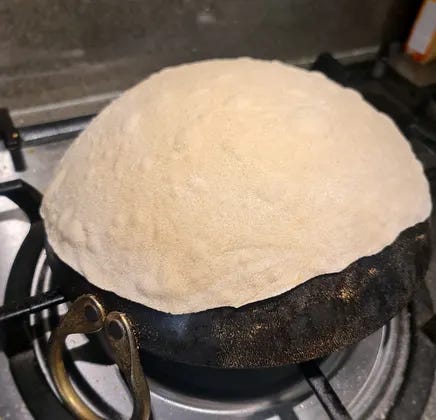

HARSHITA’S WORDS
Instant Pot Rajma : Modern comfort cooking, consistency, and adapting tradition for contemporary kitchens
My own work often sits at the intersection of food history, memory, migration, and home cooking. I am endlessly fascinated by how dishes travel, evolve, and quietly become emotional anchors for people across generations and geographies.
Through My Substack Epicurean Dispatch and my catering work, she preserves culinary heritage not as static but as living and adaptive. I tried to reflect the realities of many contemporary kitchens while still holding on to the comfort and significance of traditional food.
My Instant Pot version reflects the realities of many contemporary kitchens, especially those balancing comfort cooking with work, energy use, and limited time. In the test cook, the Chitra Rajma appeared completely intact on the outside, but beneath the surface, the beans were very well-cooked and easily mashed with light pressure. That result speaks to one of the Instant Pot’s strengths: a reliably creamy interior with comparatively little hands-on cooking.
I have been using the Instant Pot for over five years now, and honestly, it has become one of the most practical tools in my kitchen.
For dishes like rajma, it creates beautifully creamy beans with very little active supervision while keeping the cooking process consistent and efficient. Rajma can often be unpredictable, but the Instant Pot makes it far easier to manage on busy days without losing the comforting texture and flavour that make the dish special.
I also think many people get intimidated by the appliance because they assume they must always wait for the pressure to release naturally. But that is part of the convenience of the Instant Pot. Once the buzzer goes off, you can carefully release the steam manually and move straight to the next stage of cooking.
As someone balancing work, writing, research, and everyday life, I genuinely find that practicality appealing.
I do not see the Instant Pot as a replacement for traditional cooking. I see it as another chapter in the long history of Indian kitchens adapting intelligently to changing lives.
CONCLUSION
Comparison of cooking methods at a glance
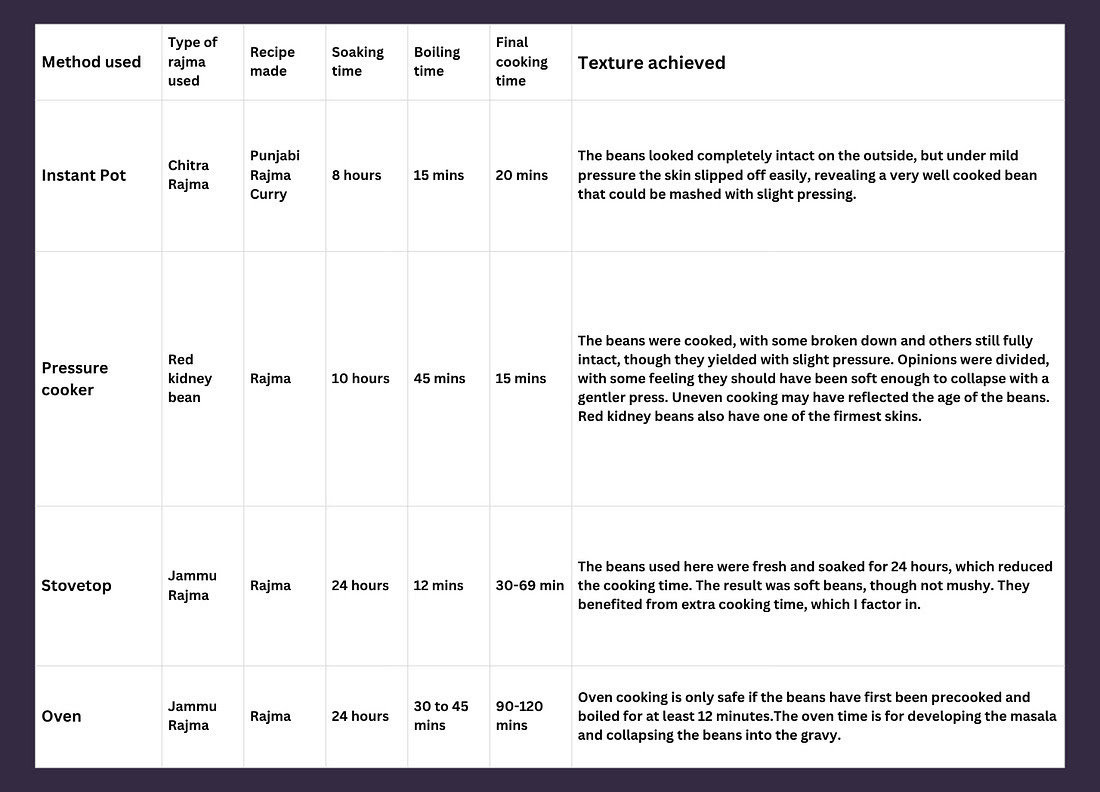
Though Lisa, Harshita and I set out to compare cooking methods, we reached an interesting conclusion. That we would almost certainly stick to our preferred methods of cooking. I will continue to use my dear PCs for all legumes. But what I will do differently next time is cook rajma with Jammu or chitra rajma.
Secondly, the final dish is a result of not only the cooking method, but also soaking time, the type of rajma used, cooking time and the age of the bean. Here’s the template I will follow - chitra rajma, soaking time 12 hours, cook in a PC with high heat, spices, onions and tomatoes. And then reduce the heat to low and cook for another 30 minutes.
If you prefer Instant Pot or stovetop/oven cooking, follow Harshita’s and Lisa’s recipe.
Irrespective of the method, you will be rewarded with comfort and siesta-inducing rajma.
Meanwhile enjoy Lisa’s science corner and deep dive into kidney beans.
 | A guest post by
|
 | A guest post by
|
I must tell you Annada, I’m really ok about using the pressure cooker to cook Rajma, it’s just that Bodhi goes into a frenzy about all the hissing.
It’s been an absolute pleasure working on this project with you and Harshita. I’ll certainly try your recipes once get the ok from Bodhi.